Monday, May 30, 2011

Alkenes & Alkynes

    Alkenes and Alkynes have similar naming rule as with Alkanes. Alkenes are hydrocarbons with one or more double bonds. There is one special property by Alkenes, some molecules have same structure but different geometry are called Geometric Isomers. There're mainly 2 types of isomers, cis and trans.

    Alkynes  are hydrocarbons with one or more triple bonds, their general formula is Cn H2n-2, they have similar naming rules to alkenes except they do not have geometric isomers.


Here is a link to show you what Alkenes and Alkynes really are:
http://www.youtube.com/watch?v=7XbYhjyUI-M

Monday, April 4, 2011

Percent Yield

    So today we did some stuff about percent yield. It is a ratio of amount of product obtained to amount of product expect. Let's simplify it, which is the grams of product recovered divided by the grams of product expected from stoichiometry. Then multiply the results by 100%. We also did something called percent purity, it is the ratio of mass of pure substance to mass of impure expressed in a percent. Which is mass of pure substance divided by mass of impure substance and multiply the results by 100%.


http://www.youtube.com/watch?v=TKNxdL7DN1I

Tuesday, March 15, 2011

Lab 6D

    So today we did a lab which is determining the limiting reactant and percent yield in a precipitation reaction. The objectives are to observe the reaction between solutions of sodium carbonate and calcium chloride; To determine which of the reactants is the limiting reactant and which is the excess reactant; to determine the theoretical mass of precipitate that should form and to compare the actual mass with the theoretical mass of precipitate and calculate the percent yield.

Monday, March 7, 2011

Stoichiometry Exercise


Is a branch of chemistry that deals with the quantitative relationships that exist between the reactants and products in chemical reactions. In a balanced chemical reaction, the relations among quantities of reactants and products typically form a ratio of whole numbers. For example, in a reaction that forms ammonia (NH3), exactly one molecule of nitrogen (N2) reacts withc)  three molecules of hydrogen (H2) to produce two molecules of NH3:
N2 + 3H2 → 2NH3

Example 1 : Ca(s) + 2HCl(aq) ----> CaCl2(aq) + H2(g)
a) How many atoms of Ca are needed to produce 1 molecule og Hydrogen?
Ans : Base on the equation : 1 mole of Ca/1 mole of Hydrogen = 1

b) How many moles of HCl are needed to produce 0.452 moles of CaCl2?
Ans : 0.452Ca x 2 moles of HCl/1 mole of Ca = 0.904mol

c) How many grams of Ca will react with 1.05moles of HCl?
Ans : 1.05moles of HCl x 1mole of Ca/2Hcl = 0.525moles of Ca

d) How many grams of CaCl2 will be formed when 2.00g of hydrogen is formed?
Ans : 2.00g/2 moles of H2 x 1 mole of CaCl2/1 mole of H x (40.1 + 35.5 x 2)g = 111.1gCaCl2

e) How many moles of of HCl are needed to form 6.12grams of CaCl2?
Ans : 6.12g of CaCl2/(40.1 + 35.5 x 2)mol of CaCl2 x 2 moles of HCl/1 mole of CaCl2 = 0.11 mol of HCl

Tuesday, March 1, 2011

Chapter 6 - Stoichiometry

  
As the definition above, Stoichiometry deals with quantitative analysis of chemical reactions, it is also the relationship between reactants used and products produced. It can use as molecules AND moles; it can also be used as conversion factors. The coefficient in balanced equations tell us the number of moles reacted or produced.

Stoichiometry calculations can predict how elements and components diluted in a standard solution react in experimental conditions. Stoichiometry is founded on the law of conservation of mass: the mass of the reactants equals the mass of the products.


A stoichiometric amount or stoichiometric ratio of a reagent is the amount or ratio where, assuming that the reaction proceeds to completion:
  1. all reagent is consumed,
  2. there is no shortfall of reagent, and
  3. no residues remain.


Here is a little video that i found on youtube that could help you understand more about Stoichiometry - http://www.youtube.com/watch?v=rESzyhPOJ7I

Thursday, February 24, 2011

Exothermic And Endothermic Reaction

An exothermic reaction is a chemical reaction that              
releases energy in the form of heat.

Expressed in a chemical equation:
reactants → products + energy
For an exothermic reaction, this gives a negative value for ΔH, since a larger value (the energy released in the reaction) is subtracted from a smaller value (the energy used for the reaction). For example, when hydrogen burns:
2H2 + O2 → 2H2O
H = −483.6 kJ/mol of O2                                                                                                      
Examples of exothermic reactions
  • Combustion reactions of fuels
  • Neutralization reactions such as direct reaction of acid and base
  • Adding concentrated acid to water
  • Burning of a substance
  • Adding water to anhydrous copper(II) sulfate
  • The thermitereaction
  • Reactions taking place in a self-heating can based on lime and aluminum
  • The setting of cementand concrete
  • Many corrosion reactions such as oxidation of metals
  • Most polymerisation reactions
  • The Haber-Bosch process of ammonia production
                                                                                                              
An endothermic reaction is a chemical reaction that          
absorbs in the form of heat.

Expressed in a chemical equation:
reactants + energy → products
 For an endothermic reaction,   this gives a positive value for ΔH, since a larger value (the energy absorbed in the reaction) is subtracted from a smaller value (the energy used for the reaction).


Some examples of endothermic processes are:[2]
  • A chemical cold pack consisting primarily of ammonium nitrate and water.
  • Evaporation of water
  • Photosynthesis


Monday, February 21, 2011

Enthalpy Calculations

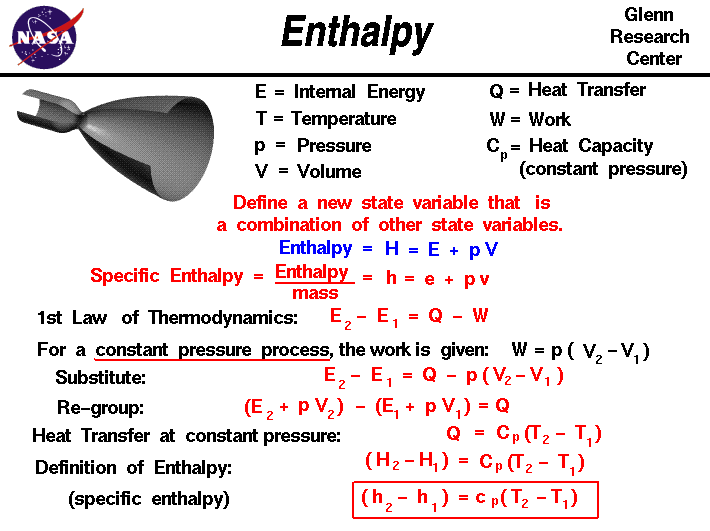
So today we did some notes on enthalpy calculations. It is  a measure of the total energy of a thermodynamics system. It includes the internal energy. Which is the energy required to create a system, and the amount of energy required to make room for it by displacing its environment and establishing its volume and pressure. Delta H is the energy change in the reaction in the kJ/mole. The enthalpy of a system is defined as: H= U + pV


This is a video that will help u understand how to calculate Delta H in some enthalpy problems: http://www.youtube.com/watch?v=NoRg7eGfb9k

Monday, February 7, 2011

Types of Chemical Reactions

    So last day we did a lab on types of chemical reactions, the types of reaction we did were synthesis, decomposition, single replacement and double replacement. So the purpose of the lab was just to observe how different chemical reactions work. We don't really have much trouble during the lab because the procedures were well written.

   I also found a link which could help us all to know more about the types of chemical reactions

http://www.youtube.com/watch?v=tE4668aarck

Tuesday, January 25, 2011

Balancing Equation

Today we are gong to talk about how to make the number of atoms of each kind on the relevant side equal to those on the product side

Here are some rules :
1. balance the atoms which only occur in one molecule on each side
2. balance the whole group
3. dont jump all over an equation
4. in an elemental form

Examples~
1. Al + CuCl2 ----> Al2Cl3 + Cu
step 1 : (4)Al + (3)CuCl2 -----> (2)Al2Cl3 + (3)Cu
step 2 : u should check if the molecules on both sides are equal
(4Al , 3Cu, 6Cl = 4Al , 3Cu, 6Cl)

2. KOH + H3PO4 -----> K3PO4 + H2O
step 1 : (3)KOH + H3PO4 ----> K3PO4 + (3)H2O
step 2 : checking
(3K, 7O, 6H, 1P  = 3K, 7O, 6H, 1P)

Monday, January 10, 2011

Diluting Solutions to Prepare Workable Solutions

We should make solutions of any concentrration from a more concentrated source.
We can make it by a simple equation.
M1V1 = M2V2

Example 1 :
Theres a 40.0mL of 0.400M NaOH solution is diluted to a final volume of 200.0mL, calculate the new concentration.
Let x be the new concentration.

0.400 x 40.0/1000.0 = 100/1000x
                             x= 6.25
The new concentration is 6.25M

Example 2 :

A 0.700M solution is concentrated by evaporation to a reduced final volume of 200.0mL and a molarity of 1.65M. Calculate the original volume.
Let V be the original volume.

0.700V = 200/1000 x 1.65
        V = 2.33
The original volume was 2.33L

Wednesday, January 5, 2011

Molar Concentration/ "Molarity" Conversation

Molarity is a number of moles of solute in 1 L of solution. We use "M" to denote molar concentration and ift has the units of "moles/L"

E.g. A 100 M solution is MORE concentrated than a 5 M solution.

Formula: Molarity = moles of solute(mol)/ volume of solution(L) aka M = mol/L

We also learned how to calculate the volume. We will learn more about this topic next class

Thursday, December 9, 2010

Formula of a Hydrate


    So today we did a lab about calculating the hydrate. One common example of the hydrate is called calcium chloride. Another common hydrate is called the carbohydrate. So here is one hydrate which is anhydrous, aka Cobalt (II) chloride.


And after i did some research in the internet, I found out there is this another form of Cobalt (II) chloride which is called Cobalt (II) chloride hexahydrate. Which looks like this


So after doing this lab I think I am much prepared for the quiz which will be next wednesday. 


Saturday, December 4, 2010

Calculate The Empirical Formula Of Organic Compound~

An organic compound : any substance that contain CARBON

When we do the calculation, we can write a balanced chemical equation for the burning of CxHy
(CxHy + zO2 -----> xCO2 + y/2H2O)

1. We should calculate the moles of CO2 and H2O produced
2. Find the mole of C and H in the CO2 and H2O
3. Find the ratio of C : H
4. Multiply the ratios to get a whole number

For example...
1.  What is the empirical formula of a compound that burns to produce 8.45g of CO2 and 1.73g of H2O?
mol of CO2 = 8.45/44 = 0.19        mol of C in CO2 = 0.19C
mol of H2O = 1.73/18 = 0.10       mol of H in H2O = 0.2H
Mole ratio = 1:1
Therefore,the empirical formula is CH

2. When 6.28g of an organic compound is burned,10.22g of CO2 and 5.18g of H2O is produced?What is the empirical formula?
mole of CO2 = 10.22/44 = 0.232   mol of C in CO2 = 0.232C
mole of H2O = 5.18/18 = 0.288     mol of H in H2O = 0.576H
Check Mass :
0.232C x 10.22g = 2.371g
0.576H x 5.18g = 2.98g
6.28g - 2.371g - 2.98g = 0.929g ----->   Oxygen
0.929/16 = 0.058mol Oxygen
Mole ratio = 0.232 : 0.576 : 0.058
                  = 4        : 10      : 1
Therefore,the empirical formula is C4H10O

Wednesday, December 1, 2010

Empirical formulas and Molecular formulas

Empirical formula: it gives the lowest term ratio of atoms (or moles) in the formula. *All ionic compounds are empirical formulas*

Ex: C3H6 (propene) ---> molecular formula
     CH2 ----> empirical formula


Molecular formula: it is a multiple of the empirical formula and shows the actual number of atoms that combine to form a molecule

Ex. A molecule has an empirical formula of C4H10 and a molar mass of 29 g/mol, what is the molecular formula
Ans: C2H5


Friday, November 26, 2010

More Mole Conversion(2)

Today we are going to teach you to solve Two Step Mole Calculartion Problems~
If we were asked to convert 22 grams of copper to atoms of copper, we'd have to go from one end of the map to the other. Instead of doing a simple one step calculation, we'd need to do a two-step calculation, with the first step going from grams to moles and the second step going from moles to atoms.

How can we solve this kind of problem? Well, we start off by doing the same thing that we did in our last example: We had to convert grams to moles before, and we can see from the map that we have to convert grams to moles now, too. To refresh your memory, here's the calculation from last time:

In the next step, we do the same thing over again, except that we need to add another T to the T-chart. When you do this, take the units of the thing at the new top left and put them on the bottom right (in this case, moles). Then take the units of what you want (in this case, atoms) and put it in the top right. Finally, put in your conversion factors, which from the chart above is Avogadro's number, or 6.02E23. Since this number refers to the number of atoms in a mole of a substance, we put this in front of "atoms of copper". Again, put the number "1" in front of moles, because we're saying that there are 6.02E23 atoms in ONE mole of an element.
When we add all these terms in, we can cross out the units that cancel out, as shown. To get the answer, multiply all the numbers on the top together and divide by the numbers on the bottom. Your answer should then be set up like this:

And that's how you do mole problems!

Tuesday, November 23, 2010

More Mole Conversions

   So today we did more mole conversions, it involves more than one step, for example,

What is the mass of 2.78 X 10 ^22 Fe atoms:  2.78 X 10^22 / 6.022 X 10^23 X 55.8 = 2.58 g

Thursday, November 18, 2010

Moles

So last class we learned about moles, and more masses. We also learned about Avogadro's hypothesis, he said if there're equal volume of different gases at the same temperature and pressure have the same number of particles. We also learned about different masses, formula mass, molecular mass and molar mass.


The last thing we learned about is Avogadro's number, the number of particles in 1 mole of any amount of substance.

6.022 x 10 ^23 particles/mole


I also found this interesting song about mole----http://www.youtube.com/watch?v=8vaaRPBXHgM

Saturday, November 13, 2010

Graphing

It's always easy to graph a picture by using computer, so that we can use Excel to record all the data and graph those data immediately and correctly.

1)First of all, we have to set up two different objects that we want to graph, one for X-intercept and the other for Y-intercept
2)Record the data you have
3)Select all the data and click SCATTER from chosing the graphing style
4)Decorate your table! (try as much change as you can :)

Wednesday, November 3, 2010

LAB 2E

So by doing today's lab we got deeper into mass, volume and density. We did the lab by using aluminum foils, find out their density and measurements and we also did some questions that are related to the measurements.
So this link below can explain more about density

http://www.youtube.com/watch?v=Q4EBOE4pJyw

Saturday, October 30, 2010

Accuracy & Precision

Accuracy : how close the measurement comes to the accepted/real value

Precision : how reproducible a measurement is compared to similar measurements

No measurement is exact. Its just a estimation. It may still has some degree of uncertainty

~Absolute uncertainty = largest difference between the average and the lowest/highest measurement
Method 1 : Calculate the average(at least 3)
For example : 8.3, 8.5 & 8.1
Average = 8.3
Absolute uncertainty = 8.5 - 8.3 = 0.2
It will recorded as 8.3+/-  0.2

Method 2 : Determine the uncertainty
Measure the best precision that you can. You should estimate to a fraction 0.1 of the smallest segment on the instrument scale.
For example :
Thermometer  Smallest : 1degree,   Best precision : 0.1degree,   uncertainty+/- : 0.1degree

~Relative Uncertainty = Absolute uncertainty/Estimated measurement