Tuesday, March 1, 2011

Chapter 6 - Stoichiometry

  
As the definition above, Stoichiometry deals with quantitative analysis of chemical reactions, it is also the relationship between reactants used and products produced. It can use as molecules AND moles; it can also be used as conversion factors. The coefficient in balanced equations tell us the number of moles reacted or produced.

Stoichiometry calculations can predict how elements and components diluted in a standard solution react in experimental conditions. Stoichiometry is founded on the law of conservation of mass: the mass of the reactants equals the mass of the products.


A stoichiometric amount or stoichiometric ratio of a reagent is the amount or ratio where, assuming that the reaction proceeds to completion:
  1. all reagent is consumed,
  2. there is no shortfall of reagent, and
  3. no residues remain.


Here is a little video that i found on youtube that could help you understand more about Stoichiometry - http://www.youtube.com/watch?v=rESzyhPOJ7I

Thursday, February 24, 2011

Exothermic And Endothermic Reaction

An exothermic reaction is a chemical reaction that              
releases energy in the form of heat.

Expressed in a chemical equation:
reactants → products + energy
For an exothermic reaction, this gives a negative value for ΔH, since a larger value (the energy released in the reaction) is subtracted from a smaller value (the energy used for the reaction). For example, when hydrogen burns:
2H2 + O2 → 2H2O
H = −483.6 kJ/mol of O2                                                                                                      
Examples of exothermic reactions
  • Combustion reactions of fuels
  • Neutralization reactions such as direct reaction of acid and base
  • Adding concentrated acid to water
  • Burning of a substance
  • Adding water to anhydrous copper(II) sulfate
  • The thermitereaction
  • Reactions taking place in a self-heating can based on lime and aluminum
  • The setting of cementand concrete
  • Many corrosion reactions such as oxidation of metals
  • Most polymerisation reactions
  • The Haber-Bosch process of ammonia production
                                                                                                              
An endothermic reaction is a chemical reaction that          
absorbs in the form of heat.

Expressed in a chemical equation:
reactants + energy → products
 For an endothermic reaction,   this gives a positive value for ΔH, since a larger value (the energy absorbed in the reaction) is subtracted from a smaller value (the energy used for the reaction).


Some examples of endothermic processes are:[2]
  • A chemical cold pack consisting primarily of ammonium nitrate and water.
  • Evaporation of water
  • Photosynthesis


Monday, February 21, 2011

Enthalpy Calculations

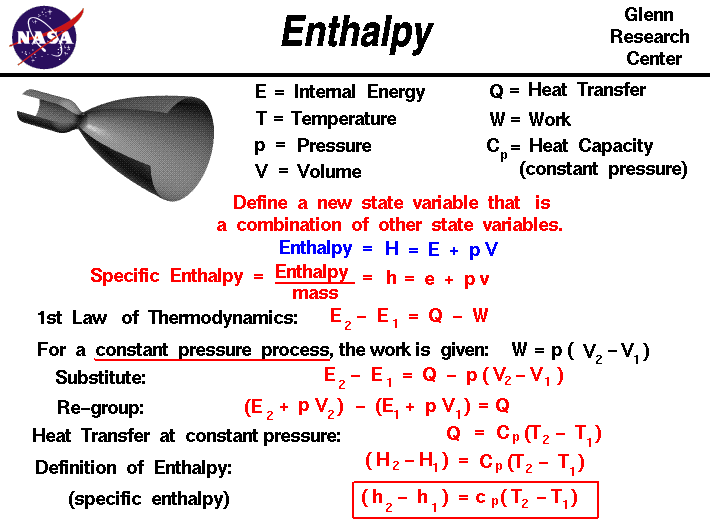
So today we did some notes on enthalpy calculations. It is  a measure of the total energy of a thermodynamics system. It includes the internal energy. Which is the energy required to create a system, and the amount of energy required to make room for it by displacing its environment and establishing its volume and pressure. Delta H is the energy change in the reaction in the kJ/mole. The enthalpy of a system is defined as: H= U + pV


This is a video that will help u understand how to calculate Delta H in some enthalpy problems: http://www.youtube.com/watch?v=NoRg7eGfb9k

Monday, February 7, 2011

Types of Chemical Reactions

    So last day we did a lab on types of chemical reactions, the types of reaction we did were synthesis, decomposition, single replacement and double replacement. So the purpose of the lab was just to observe how different chemical reactions work. We don't really have much trouble during the lab because the procedures were well written.

   I also found a link which could help us all to know more about the types of chemical reactions

http://www.youtube.com/watch?v=tE4668aarck

Tuesday, January 25, 2011

Balancing Equation

Today we are gong to talk about how to make the number of atoms of each kind on the relevant side equal to those on the product side

Here are some rules :
1. balance the atoms which only occur in one molecule on each side
2. balance the whole group
3. dont jump all over an equation
4. in an elemental form

Examples~
1. Al + CuCl2 ----> Al2Cl3 + Cu
step 1 : (4)Al + (3)CuCl2 -----> (2)Al2Cl3 + (3)Cu
step 2 : u should check if the molecules on both sides are equal
(4Al , 3Cu, 6Cl = 4Al , 3Cu, 6Cl)

2. KOH + H3PO4 -----> K3PO4 + H2O
step 1 : (3)KOH + H3PO4 ----> K3PO4 + (3)H2O
step 2 : checking
(3K, 7O, 6H, 1P  = 3K, 7O, 6H, 1P)

Monday, January 10, 2011

Diluting Solutions to Prepare Workable Solutions

We should make solutions of any concentrration from a more concentrated source.
We can make it by a simple equation.
M1V1 = M2V2

Example 1 :
Theres a 40.0mL of 0.400M NaOH solution is diluted to a final volume of 200.0mL, calculate the new concentration.
Let x be the new concentration.

0.400 x 40.0/1000.0 = 100/1000x
                             x= 6.25
The new concentration is 6.25M

Example 2 :

A 0.700M solution is concentrated by evaporation to a reduced final volume of 200.0mL and a molarity of 1.65M. Calculate the original volume.
Let V be the original volume.

0.700V = 200/1000 x 1.65
        V = 2.33
The original volume was 2.33L

Wednesday, January 5, 2011

Molar Concentration/ "Molarity" Conversation

Molarity is a number of moles of solute in 1 L of solution. We use "M" to denote molar concentration and ift has the units of "moles/L"

E.g. A 100 M solution is MORE concentrated than a 5 M solution.

Formula: Molarity = moles of solute(mol)/ volume of solution(L) aka M = mol/L

We also learned how to calculate the volume. We will learn more about this topic next class